If you are thinking about buying recreational land near Wisconsin Dells, Juneau County deserves a serious look. This is not a typical housing market where you can judge a property by a few nearby sales and a quick drive-by. In Juneau County, the real value often comes down to access, habitat, water, topography, and whether the land actually fits how you plan to use it. Let’s dive in.
Why Juneau County stands out
Juneau County has the kind of land mix that draws outdoor-minded buyers. County planning data shows the county is made up of about 54.89% woodland, 20.77% agriculture, 11.02% open lands, and 5.35% water, while only 2.12% is residential development. That tells you right away this is a rural, recreation-driven market, not a subdivision market in disguise.
The county also offers real variety on the ground. According to the county forest plan, Juneau County sits mainly within the Central Sand Plains and Western Coulee and Ridges, with terrain that ranges from gently rolling areas to steeper, hillier ground. For you as a buyer, that can affect everything from trail layout and hunting cover to drainage, road building, and where a cabin site will work best.
Its location near Wisconsin Dells adds another layer of appeal. The Dells welcomes more than four million visitors a year and has more than 10,000 lodging rooms, which helps explain the continued interest in weekend getaways and recreational property in nearby areas. Still, in this market, convenience alone does not make a parcel great. The best tracts usually combine usable acreage, legal access, and strong natural features.
What recreational buyers look for
In Juneau County, buyers tend to focus on utility first. A property may look attractive online, but that does not tell you how it hunts, how it lays, or whether you can realistically build or improve it. Rural land needs to match your actual goals from day one.
If you are comparing parcels, pay close attention to these factors:
- Legal, year-round access
- Build-site potential
- Well and septic feasibility
- Habitat diversity
- Topography and drainage
- Water features or proximity to water
- Nearby public land and how it affects use
- Tax-law status and any public-access implications
That framework matters because Juneau County has a large public-recreation presence. Public land can be a major benefit, but it can also change how private land feels and functions.
Public land shapes the market
One reason Juneau County is so attractive for recreation is the scale of nearby public land. Necedah National Wildlife Refuge is entirely in Juneau County, with most of it north of Highway 21 and west of Highway 80. Visitors use it for hiking, snowshoeing, cross-country skiing, hunting, fishing, wildlife photography, and wildlife observation.
That access creates lifestyle value, but it also calls for practical thinking. The refuge notes that many township roads are seasonal or under construction, and some local roads are dead ends. If you are buying land nearby, do not assume the road on a map gives you simple, year-round access.
Meadow Valley Wildlife Area adds even more public recreation to the area. At about 56,000 acres, it borders the refuge on the west side and is managed for public hunting and other compatible recreation. For some buyers, neighboring public land is a huge plus. For others, it may mean more nearby hunting pressure or more seasonal traffic than expected.
Water features add appeal and complexity
Water plays a big role in Juneau County’s identity. Buckhorn State Park and adjacent state wildlife areas cover more than 8,000 acres on a peninsula in the Castle Rock Flowage, offering camping, canoeing, fishing, and other recreation. Yellow River Wildlife Area adds another 2,188 acres on Castle Rock Lake in east-central Juneau County.
For buyers, water adjacency can be a strong value driver. A parcel near a lake, flowage, creek corridor, or wetland edge may offer better views, wildlife movement, and year-round enjoyment. At the same time, waterfront and wetland parcels usually need deeper review before you move forward.
The Wisconsin DNR regulates activities below the ordinary high water mark and in wetland areas. Local governments regulate setbacks and activities above the ordinary high water mark in shoreland zones and regulated floodplains. In unincorporated towns, the shoreland zone extends 1,000 feet from navigable lakes and 300 feet from navigable streams, including their floodplains.
That means a waterfront parcel may not be as straightforward as it looks. If you want to build, improve access, or place structures, you need to understand what is regulated before you buy. Juneau County also has shoreland-wetland and floodplain zoning ordinances that can affect use.
Access should be your first checkpoint
When buying raw recreational land, access should be one of the first things you verify. In a market like Juneau County, map appearance and real-world access are not always the same. A parcel can look simple on a screen but become much more complicated when you confirm frontage, easements, road conditions, and seasonal use.
The DNR notes that its public land tools may require county plat books to identify ownership boundaries, roads, rivers, lakes, and other physical features. The agency also notes that many public-land roads can be seasonal or restricted. That is why you want to confirm deeded frontage, easements, and year-round ingress and egress, not rely on assumptions.
A good parcel should answer a few basic questions clearly:
- Do you have legal access to the property?
- Is the access practical in all four seasons?
- Is the road public, private, or seasonal?
- Will trucks, equipment, or building materials be able to reach the site?
- Are there any dead-end road or maintenance issues nearby?
Buildability matters more than many buyers expect
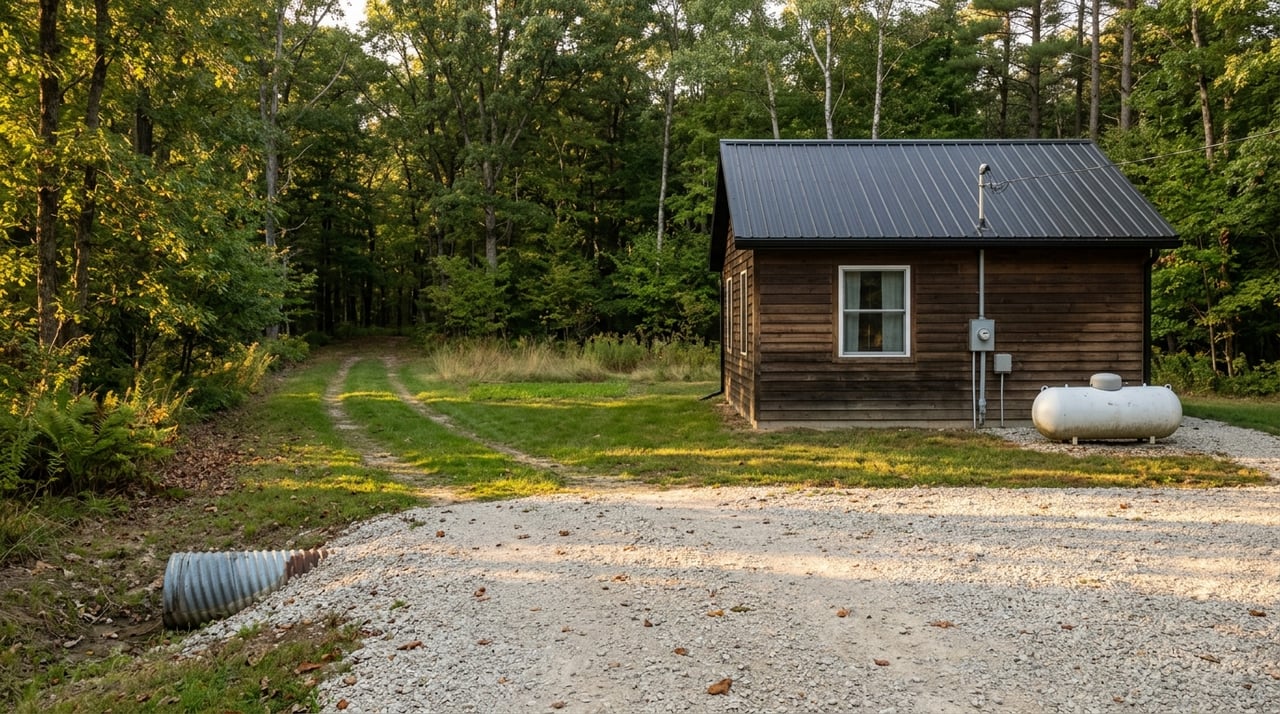
A lot of recreational buyers want at least the option to add a cabin, campsite, or future home. In Juneau County, that means you need to think beyond the tree line and ask whether the property can support your plans. Utilities are often the next major limiting factor after access.
The Wisconsin DNR says state law does not require a well inspection or water testing during a property transfer, but buyers may choose to have the well and pressure system inspected, water tested, and unused wells searched. If that work is done, it must be performed by a licensed well driller or licensed pump installer. For vacant land, that means you should not assume water service will be simple just because neighboring properties have wells.
Wastewater is another major issue. The Department of Safety and Professional Services says its POWTS program regulates onsite wastewater systems, and county agencies usually handle the primary inspection role. If the property is not served by municipal sewer, it makes sense to evaluate soil and site suitability early in the process.
Tax-law status can affect how land feels
One detail many buyers miss is how tax-law enrollment on nearby land can affect privacy and access. In Wisconsin, Managed Forest Law lands that are open to public access allow hunting, fishing, hiking, sightseeing, and cross-country skiing. Forest Crop Law lands allow hunting and fishing.
The DNR also says Voluntary Public Access lands may be open for hunting, fishing, trapping, and wildlife observation, while camping and vehicles are prohibited. Open status can change from year to year, so you should verify current enrollment rather than assume neighboring ground is permanently open or closed.
This matters in two directions. Open neighboring land may create added recreation opportunities in the area, but it may also reduce the sense of seclusion some buyers want. If privacy is high on your list, this is worth checking carefully.
How to judge value near Wisconsin Dells
Being near Wisconsin Dells can improve convenience for a weekend property. You may be able to reach your land more easily for short trips, and the area’s tourism draw can support interest in cabin and getaway-style properties. But proximity alone should not outweigh the basics.
In this part of Wisconsin, the strongest parcels are usually the ones that deliver on intended use without major surprises. If you want hunting land, habitat diversity, cover, and access patterns matter. If you want a future cabin site, well and septic feasibility, topography, and zoning constraints matter just as much as scenery.
That is why land buyers need a different lens than homebuyers. Standard residential comps only tell part of the story. Recreational land value often lives in details you can walk, map, and verify, including trail layout, water influence, usable acreage, and the pressure created by nearby public recreation.
A smart buying approach
If you are serious about buying recreational land in Juneau County, it helps to rank each property in the same order every time. That keeps emotion from taking over too early and helps you compare tracts on the factors that really matter.
A simple way to evaluate a parcel is to score it by:
- Legal and practical access
- Build-site quality
- Well and septic feasibility
- Habitat and cover
- Topography and drainage
- Water influence
- Nearby public land impact
- Long-term fit for your goals
That kind of process is especially useful in a county where rural housing is scattered and recreational demand often centers around lakes, streams, timber, and open ground. The right parcel is not always the prettiest one at first glance. It is the one that fits your plans with the fewest hidden issues.
If you want help sorting through acreage near Wisconsin Dells, Brandon Wikman brings the kind of land-focused perspective that recreational buyers need. From access and topography to habitat, buildability, and long-term use, you can make a better decision when you evaluate rural property like land first and real estate second.
FAQs
What makes recreational land in Juneau County different from regular residential property?
- Recreational land in Juneau County is usually valued more by access, habitat, topography, water features, and buildability than by standard residential comparables.
What should you verify first when buying raw land in Juneau County?
- You should verify legal access, deeded frontage or easements, and whether the property has practical year-round ingress and egress.
What should you know about waterfront land in Juneau County?
- Waterfront and wetland parcels may be affected by DNR regulations, local shoreland zoning, floodplain rules, and ordinary high water mark issues, so they need careful review before purchase.
What public recreation areas affect land buying in Juneau County?
- Major public recreation areas include Necedah National Wildlife Refuge, Meadow Valley Wildlife Area, Buckhorn State Park, and Yellow River Wildlife Area.
What utility issues matter for recreational land near Wisconsin Dells?
- Buyers should look closely at well options, water testing, and onsite wastewater feasibility because vacant or rural parcels may not have simple utility solutions.
What should you know about open tax-law land in Juneau County?
- Managed Forest Law, Forest Crop Law, and Voluntary Public Access enrollment can affect nearby public use, and status can change, so current enrollment should always be verified.